En-VISIONBOARDING Your Third Act
Last week we hosted an “En-visionboard-ing your retirement lifestyle” event for our July Money Speakeasy topic. I will admit that in the past, I used to be a vision board skeptic- too dreamy and arts-n-crafts for me. But a few years ago I attended a Valentine’s Day goal-setting vison board event and I LOVED it. It was so much fun to flip through magazines and cut out my favorite images and words that ‘spoke’ to me. I got in touch with my inner child, used my imagination, allowed myself to dream and put that down on the poster board. At the end of the event, I had a pretty colorful collage that told a very sunny, beachy, dog-friendly, adventurous, delicious and wine-inspired story.
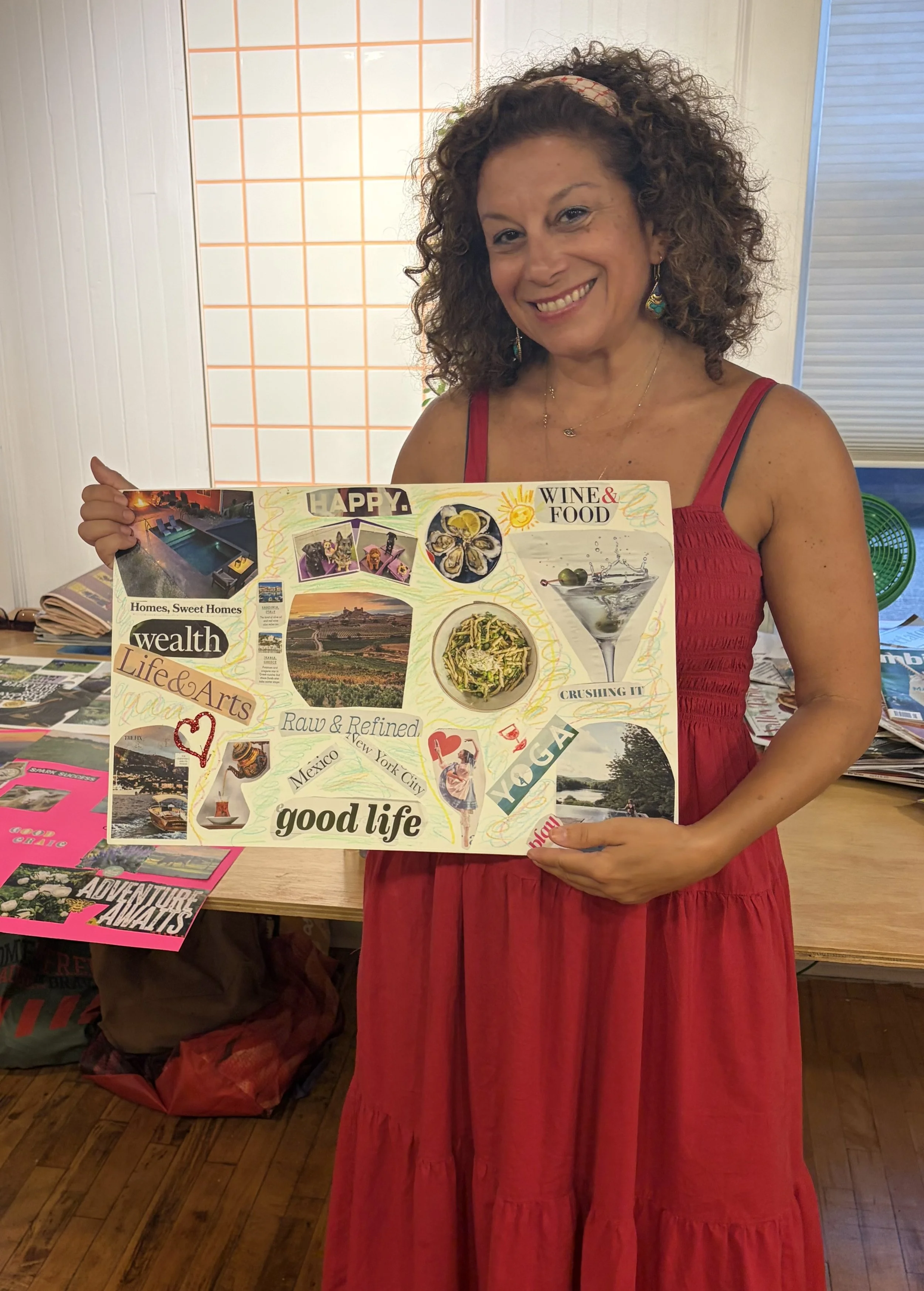
VISION BOARDING IS THE NEW BOOK CLUB?
We had a dearth of lifestyle, food & wine, Hudson Valley-based and celebrity gossip magazines, so I didn’t get a lot of travel inspo but definitely had enough to showcase some goals :)
Prepping for our event, I wasn’t sure what supplies to collect. I gathered tons of magazines from friends and neighbors, then went wandering through the aisles of Michael’s craft store. Being a childless Gen-Xer I didn’t have the experience of getting a kid ready for a new school year or volunteering to help on school projects; I only had a vague idea of what one would need for a successful arts-n-crafts event.
So I was confused when I asked one of the Michael’s employees where I could find scissors, and they met me with “what kind of scissors are you looking for?”
“I mean, regular scissors.”
“For fabric or paper? Children’s scissors?” The nice lady was trying to be helpful.
“Ok sure,” I replied. Whatever, I will make children’s scissors work, I decided.
“Check aisles 90, 34 and 17,” and she walked away.
Fortunately I found a package of 4 all-purpose scissors in aisle 34 and I was set.
I picked up glue sticks, clear Elmer’s glue, sprinkles, magic markers, crayons. And candy—a very important part of the vision boarding experience.
The event drew a lively group of women and even one man! We grabbed our poster board and spread out, and started to flip through magazines with gusto. Funny how the conversation flows when our hands are busy and minds switch to creative mode. Since ‘envisioning your retirement lifestyle’ was the theme of the vision boards, it was interesting to hear what everyone was dreaming of. One person decided that Ireland would be her last stop on this planet—she imagined living a quiet life in a quaint village surrounded by pubs and sheep. Another wanted to remain rooted in her community and living a life of outdoor adventures as long as she is able. Another attendee was all about exploring sustainable food sources and feeding the community.
For most of us, connection, travel, freedom and meaning were common themes on our boards. There didn’t seem to be the typical ideas of how people might think of retirement—a sedentary lifestyle, downsizing, golf all day, building a life in a retirement community.—not that there is anything wrong with those aspirations. It was enlightening what our vison boards revealed: that for many of us, our third act would be busy, intentional, surrounding ourselves with people and issues we care about, adventure-seeking and actively leveraging the experiences we’ve had in our lives, and sharing expertise to build stronger communities.
Naturally, conversation also flowed to the HOW. How do we afford the life we aspire to live in retirement? Of course, as much as getting to retirement is personal, so is getting through it. But there are some universal themes for preparing for the third act of your dreams.
1. Calculate what your average annual spending will be in retirement. The rule of thumb for most people is that you will need to replace about 60-70% of your pre-retirement income to maintain a similar lifestyle when you stop working. So if you earn $100k (pre-tax) now, expect to need about $70k (adjusted for inflation) to pay for your retirement lifestyle.
- This will vary based on your lifestyle during your working years, but the ‘bigger’ your lifestyle (i.e. how much discretionary income you spend on travel, clothes, experiences) the more wiggle room you might have in retirement. The lower your pre-retirement income, the more likely that Social Security will replace most of your necessary spending, supplemented by retirement accounts and other savings.
- Remember that when you retire, you presumably stop saving and your taxes decrease (although that varies), along with other pre-retirement spending.
2. Figure out how much ‘fixed’ income you’ll be receiving from Social Security, annuity income and pensions. Determine what sources of fixed income you’re getting and how much that will be—in some cases, Social Security and pension income could cover the bulk of necessary spending, in some cases it might be minimal.
- The more fixed income you will receive, the more risk you might be able to take in your other retirement investments.
- You can also think of what sources of income will cover what expenses. For example, your fixed costs could be covered by your fixed income; discretionary costs could be covered by some investments; legacy could be covered by whatever is left.
3. Make a plan. As a financial advisor, I have seen how clients have shifted their retirement mindset to confidence as soon as we built a plan for them. A robust financial plan will include life expectancy (I always use a ‘worst-case scenario of living to 100), expected spending in retirement adjusted for inflation, estimated income sources including their Social Security benefit, pension income, retirement accounts and investment accounts.
- Creating a plan means that not only do we include current assumptions but we can also test the plan with ‘what-if’ scenarios, like what if Social Security changes, a health event occurs or someone dies prematurely. We can also include the sale of a business or the family house and subsequent downsizing, build a travel budget or change of lifestyle.
My takeaway from the vision-boarding event: most people don’t dream of a wealthy, extravagant lifestyle in retirement. Instead, most people expect their third act to be an extension of their current lifestyle with more time peppered in, and whatever they’ve been building in their lifetime: enjoying family and friends, a balance of rest and adventure, pursuing the activities that make them happy. And for most of us, it doesn’t take massive wealth to do this—but it does take planning and an awareness of how we spend, how much we save and what changes we need to enact to make our retirement dreams doable. So dream big and make that vision board—but don’t forget to take stock and build a sustainable plan while you can.